Mesothelioma is a rare cancer caused by asbestos exposure, and it develops in the tissue lining the lungs, abdomen, heart, and, in rarer cases, the testes. While it cannot be cured, it is treatable. Chemotherapy, immunotherapy and surgery can extend life and improve quality of life. Early diagnosis significantly improves treatment options and survival.
Mesothelioma is a primary cancer of the lining of the lung and chest wall.
So the pleura is the lining of the chest wall and lung. In a healthy person, it's like a cellophane wrap around the chest wall, the middle compartment of the chest where the sac around the heart is, the diaphragm that separates the chest and the abdomen, and the entire surface of the lung, deep into the crevices of each of the individual sections. In mesothelioma, that cellophane becomes thickened with tumor, almost like a blanket.
Now this differs from other cancers that go to that lining. In fact, it is even more common for people to get other cancers such as breast, lung, or other organs that go to the lining of the lung. That's considered metastatic, or meaning cancer going from one location to another part of the body or another organ. And so mesothelioma is when the cancer starts in the pleura or that lining.
Mesothelioma is a primary cancer of the lining of the lung and chest wall.
So the pleura is the lining of the chest wall and lung. In a healthy person, it's like a cellophane wrap around the chest wall, the middle compartment of the chest where the sac around the heart is, the diaphragm that separates the chest and the abdomen, and the entire surface of the lung, deep into the crevices of each of the individual sections. In mesothelioma, that cellophane becomes thickened with tumor, almost like a blanket.
Now this differs from other cancers that go to that lining. In fact, it is even more common for people to get other cancers such as breast, lung, or other organs that go to the lining of the lung. That's considered metastatic, or meaning cancer going from one location to another part of the body or another organ. And so mesothelioma is when the cancer starts in the pleura or that lining.
“I've spoken to many mesothelioma patients that have been in your shoes that you're in today, and I still keep in touch with them 10 years later. What frustrates me the most, and I hear this almost every time I have a new patient that calls me or I speak to, ‘I just saw my doctor today, and they said… the average life expectancy is 12 to 16 months.’ Every patient is different. Until they know the stage, the cell type and how the patient's going to respond to their treatment, they have no idea what their life expectancy is. So I always encourage patients to know: You're an individual. This is your story, and let's make the most of your story.”
Karen Selby, registered nurse and Patient Advocate at The Mesothelioma Center
“Mesothelioma is a primary cancer of the lining of the lung [pleura] and chest wall. In a healthy person, it's like a cellophane wrap around the chest wall, the middle compartment of the chest where the sac around the heart is, the diaphragm that separates the chest and the abdomen, and the entire surface of the lung, deep into the crevices of each of the individual sections. In mesothelioma, that cellophane becomes thickened with tumor, almost like a blanket.”
Dr. Andrea Wolf, director of the Women’s Lung Cancer Program at Mount Sinai
“My advice for anyone currently battling mesothelioma is to be well educated. Know that there are resources out there that you’re not really alone. You really aren’t, even if you don’t have a husband, a wife, a partner, children or siblings. There are people out there that will help you. Seek them out.”
Kim Madril, pleural mesothelioma survivor
Annual cases: About 3,000 people are diagnosed each year in the U.S.
Cancer type: Malignant mesothelioma (aggressive cancer requiring specialist care)
Latency period: 20 to 60 years between exposure and symptoms
Who’s Most Affected: Men over age 65
Average survival: 12 months, but treatment extends life expectancy
Curability: Incurable but treatable with chemotherapy, immunotherapy and surgery
“I've spoken to many mesothelioma patients that have been in your shoes that you're in today, and I still keep in touch with them 10 years later. What frustrates me the most, and I hear this almost every time I have a new patient that calls me or I speak to, ‘I just saw my doctor today, and they said… the average life expectancy is 12 to 16 months.’ Every patient is different. Until they know the stage, the cell type and how the patient's going to respond to their treatment, they have no idea what their life expectancy is. So I always encourage patients to know: You're an individual. This is your story, and let's make the most of your story.”
Karen Selby, registered nurse and Patient Advocate at The Mesothelioma Center
“Mesothelioma is a primary cancer of the lining of the lung [pleura] and chest wall. In a healthy person, it's like a cellophane wrap around the chest wall, the middle compartment of the chest where the sac around the heart is, the diaphragm that separates the chest and the abdomen, and the entire surface of the lung, deep into the crevices of each of the individual sections. In mesothelioma, that cellophane becomes thickened with tumor, almost like a blanket.”
Dr. Andrea Wolf, director of the Women’s Lung Cancer Program at Mount Sinai
“My advice for anyone currently battling mesothelioma is to be well educated. Know that there are resources out there that you’re not really alone. You really aren’t, even if you don’t have a husband, a wife, a partner, children or siblings. There are people out there that will help you. Seek them out.”
Kim Madril, pleural mesothelioma survivor
Annual cases: About 3,000 people are diagnosed each year in the U.S.
Cancer type: Malignant mesothelioma (aggressive cancer requiring specialist care)
Latency period: 20 to 60 years between exposure and symptoms
Who’s Most Affected: Men over age 65
Average survival: 12 months, but treatment extends life expectancy
Curability: Incurable but treatable with chemotherapy, immunotherapy and surgery
What Is Mesothelioma?
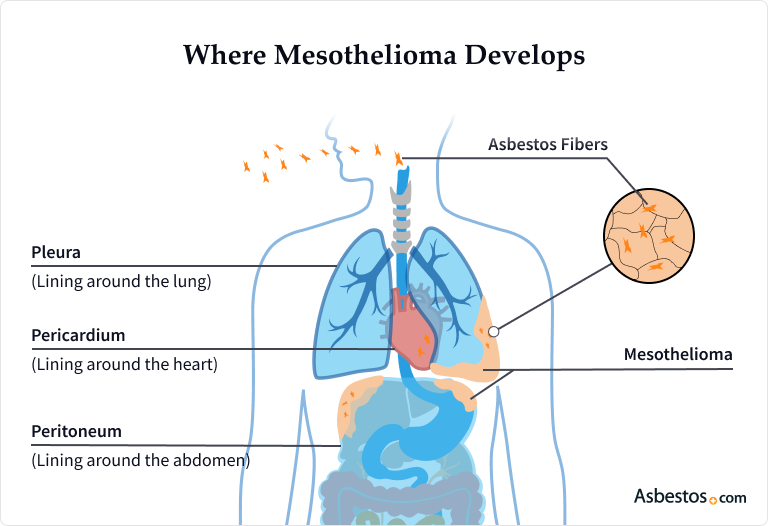
Mesothelioma may develop in the lining around the lungs, abdomen or heart.
Mesothelioma develops when asbestos fibers become trapped in the mesothelium, the protective tissue lining your organs. These fibers cause chronic inflammation and DNA damage, transforming normal cells into cancer. However, early diagnosis and treatment by specialists significantly improve survival rates.
Early diagnosis is critical because it gives you more treatment options and better outcomes. Mesothelioma patients are living longer than before. Long-term mesothelioma survivors Kim Madril, Tamron Little and Michael Cole show that with specialized care and cutting-edge treatment, it’s possible to exceed average survival statistics.
“I saw my kid graduate from high school,” said Madril, who was diagnosed with pleural mesothelioma in 2019. “I’m so glad that I’m not suffering like I did initially…You’re almost grateful for what you have. I’m grateful that I am still here. I am so happy that I’m still here. Embrace the moment.”
Survivor Experience
My story begins at the end of April 2015, when I went to my general practitioner’s office because of a cough and an unusual lack of energy. I thought maybe I was coming down with a case of pneumonia.
There are 4 main types of mesothelioma. Mesothelioma forms in the lining around the lungs (pleura), abdomen (peritoneum), heart (pericardium) or testes (tunica vaginalis).
Pleural Mesothelioma
Prevalence: 70% to 79% of all cases
Location: Pleura (tissue around lungs and chest wall)
Treatments: Immunotherapy, surgery, chemotherapy
5-year survival rate: 7% to 22%, according to the American Cancer Society
Peritoneal Mesothelioma
Prevalence: 10% to 30% of all cases, second most common type
Location: Peritoneum (abdominal cavity lining)
Treatments: HIPEC surgery is highly effective for this type
5-year survival rate: 65% (significantly better than pleural)
Pericardial Mesothelioma
Prevalence: About 1% of cases (very rare)
Location: Pericardium (sac around the heart)
Median survival: 2 to 6 months
Treatment challenges: Limited options because of heart proximity
Testicular Mesothelioma
Prevalence: Less than 1% of cases, rarest form
Location: Tunica vaginalis (membrane around testes)
Common symptom: Testicular mass or swelling
Prognosis: Better than other types, 33% of patients live 10+ years
Mesothelioma can spread from one location to another as it progresses. In rare cases, a person may develop both pleural and peritoneal mesothelioma. Pleural and pericardial types often share symptoms like chest pain and difficulty breathing, which can complicate diagnosis.
FREE MESOTHELIOMA GUIDE
Expert Guidance for Your Mesothelioma Journey
Get answers about treatment, top doctors, and financial support from the nation’s most trusted mesothelioma resource.
The most common symptoms of mesothelioma include fatigue, weight loss and fever. These symptoms develop slowly and often resemble common respiratory infections, such as pneumonia or bronchitis, making early diagnosis difficult. If you have a history of asbestos exposure and experience persistent symptoms, see a mesothelioma specialist immediately.
Most Common Mesothelioma Symptoms by Type
Symptom
Pleural (Lung)
Peritoneal (Abdomen)
Pericardial (Heart)
Testicular (Testes)
Shortness of breath
X
X
Chest pain or tightness
X
X
Persistent dry cough
X
X
Abdominal pain
X
Abdominal swelling
X
Unexplained weight loss
X
X
X
Fatigue or weakness
X
X
X
X
Fever or night sweats
X
X
X
Loss of appetite
X
X
Nausea or vomiting
X
Heart palpitations
X
Difficulty breathing when lying down
X
Testicular mass or swelling
X
Fluid buildup
X
X
X
X
What Is the Main Cause of Mesothelioma?
Asbestos exposure is the primary cause of mesothelioma. When people inhale or ingest microscopic asbestos fibers, the fibers become trapped in the mesothelium, the protective lining of organs. As Dr. Marcelo DaSilva, chief of thoracic surgery at AdventHealth Cancer Institute, explains, these inhaled fibers lead to inflammation, which can then cause cancer to develop.
Dr. DaSilva tells us, asbestos “causes chronic inflammation in the mesothelium. This can lead to genetic changes.” As this inflammation causes DNA changes in the cells, they can become mesothelioma cancer cells.
Asbestos is a toxic mineral once widely used in construction, shipbuilding, military equipment and industrial products. Most people with mesothelioma were exposed decades ago, often without knowing the dangers.
It takes decades after initial asbestos exposure for mesothelioma to develop, which is why most patients get diagnosed in their 60s or 70s.
Who Is Most at Risk?
People with occupational asbestos exposure face the highest risk of developing mesothelioma. Workers in construction, shipbuilding, manufacturing and the military were regularly exposed before asbestos regulations took effect in the 1970s and 1980s.
High-Risk Occupations
Auto mechanics: Brake repair and clutch work released asbestos dust
Construction workers and demolition crews: Exposed through insulation, drywall and floor tiles
Electricians and HVAC technicians: Handled asbestos-containing wiring, panels and ductwork insulation
Industrial workers: Manufacturing facilities used asbestos in production processes
Insulation installers: Direct handling of asbestos products
Pipefitters and plumbers: Worked with asbestos pipe insulation and gaskets
Shipyard workers and Navy veterans: Especially those who served before 1980
Family members and people living near asbestos sites also face elevated risk. Secondhand exposure occurs when workers bring asbestos fibers home on clothing, skin or hair. Spouses who laundered work clothes and children who greeted parents after work shifts faced significant exposure.
“It started with me going down to the Oneida County Courthouse in Utica, New York, with my dad,” pleural mesothelioma survivor Carla Fasolo remembers about her asbestos exposure. “I would go down there with him, and it was very dusty in the boiler room. There would be chunks of gray, fibrous stuff down there. I didn’t know what it was, but I’d pick it up and play with it.”
Survivor Story
Kim Madril: My Experience Facing Mesothelioma
My name is Kim Madril, and I’m 62 years old. I was diagnosed with pleural mesothelioma, in July of 2019, and I am a mesothelioma survivor.
I woke up one early morning at 3 a.m.
And I had this sharp shooting pain on the left side. And so my PCP finally said, Kim, let’s just get CAT scan. Okay?
And it was July of 2019 when I was definitively diagnosed.
I did run marathons. I was active. I climbed Mount Kilimanjaro.
It just didn’t seem real.
I think my mom having lost her husband at 55, you know. I think she thought, oh my gosh. Am I gonna lose my kid?
My surgery ended up being about 8 hours.
When I woke up, I remember thinking, I made it.
I made it. And, really, after that, I thought okay, you’re gonna be fine, Kim. You’re gonna be fine.
My advice for anyone currently battling mesothelioma is to be well educated. Know that there are resources out there that you’re not really alone. You really aren’t, even if you don’t have a husband, a wife, a partner, or children, or siblings.
There are people out there that will help you. Seek them out.
Environmental Exposure and Genetic Risk Factors
Environmental exposure affects people living near asbestos mines, processing plants or contaminated sites. Communities near vermiculite mines in Libby, Montana, and shipyards in port cities experienced elevated mesothelioma rates even among residents who never worked with asbestos directly.
No amount of asbestos exposure is considered safe. Even brief or low-level exposure can cause mesothelioma decades later.
While asbestos is the primary cause of mesothelioma, family history and genetic mutations (like BAP1) may increase susceptibility. Smoking does not cause mesothelioma but significantly increases the risk of asbestos-related lung cancer.
If You’ve Been Exposed to Asbestos
Talk to your doctor about screening if you worked in high-risk occupations, served in the military (especially Navy), lived with someone who worked with asbestos or have a family history of mesothelioma. Screening options include chest X-rays, low-dose CT scans and regular monitoring for early detection. Mesothelioma requires care from medical oncologists, thoracic surgeons, pulmonologists and radiation oncologists.Learn about top mesothelioma doctors
Diagnosing and Staging Mesothelioma
Confirming a mesothelioma diagnosis requires multiple tests and expert analysis. Doctors use imaging scans, blood tests and biopsies to identify cancer cells and determine how far the disease has spread. A biopsy is the only definitive way to diagnose mesothelioma. Imaging and blood tests alone cannot confirm cancer.
If you have a history of asbestos exposure, tell your doctor immediately. This information helps them order the right diagnostic tests and avoid delays. Many patients are initially misdiagnosed with pneumonia, bronchitis or COPD because early symptoms overlap with common respiratory conditions.
Test to Diagnose Mesothelioma
Physical examination and medical history: Checks for lumps, fluid buildup and asbestos exposure history
Imaging tests: Chest X-rays, CT scans, MRIs and PET scans reveal abnormalities and tumor locations
Blood tests: Detect biomarkers like SMRP, fibulin-3 and osteopontin (elevated levels suggest mesothelioma)
Biopsy: The only definitive diagnostic test. Pathologists examine tissue samples under a microscope to confirm cancer cells.
Your diagnosis identifies three critical factors: mesothelioma type, cell type and stage. These details determine your treatment options and prognosis. Cell type significantly impacts treatment response. Epithelioid mesothelioma responds best to chemotherapy and immunotherapy. Sarcomatoid and biphasic types are more resistant. Knowing your cell type helps your doctor select the most effective treatment approach for your specific case.
As of 2025, the American Society of Clinical Oncology now recommends genetic testing for mesothelioma. Testing identifies BAP1 gene mutations, found in 20% to 25% of patients. Research shows patients with BAP1 mutations respond better to chemotherapy and immunotherapy, with improved survival outcomes.
Cell Type Treatment Comparison
Cell Type
Prevalence
Median Survival
Treatment Response
Epithelioid
50% to 70% of cases
14 to 24 months
Best response
Sarcomatoid
10% to 20% of cases
8 to 12 months
Limited response
Biphasic
20% to 30% of cases
10 to 13 months
Variable
Mesothelioma Stages
Mesothelioma staging describes how far the cancer has spread. Stages 1 and 2 are early stages, and stages 3 and 4 are late stages. Early stages offer more treatment options, while advanced stages offer fewer.
The TNM Staging System for Pleural Mesothelioma
T: Tumor size and extent (T1 to T4)
N: Lymph node involvement (N0 to N3)
M: Metastasis to distant organs (M0 or M1)
Your stage determines which treatments you’re eligible for, including curative-intent surgery for early-stage disease. Unfortunately, more than 70% of patients are diagnosed at stage 3 or 4, which limits treatment options. This is why screening is critical for anyone with asbestos exposure history.
Percent of Patients Diagnosed by Stage and Gender
% of Total Diagnosed
% of Men
% of Women
Stage 1
18%
18%
24%
Stage 2
11%
11%
12%
Stage 3
23%
23%
20%
Stage 4
48%
48%
44%
Source:
The Mesothelioma Center at Asbestos.com, 2025
How Is Mesothelioma Treated?
Mesothelioma is treated with chemotherapy, immunotherapy, surgery and radiation therapy, often used in combination for better outcomes. While mesothelioma cannot be cured, these treatments can extend life, reduce symptoms and improve quality of life.
In 2025, the ASCO updated treatment guidelines for pleural mesothelioma. The new guidelines recommend chemotherapy alone versus the previous standard of combining chemotherapy with surgery for some patients. However, treatment decisions should be individualized. Your mesothelioma specialist will determine the best approach based on your specific case.
Common Treatment Options
Chemotherapy: Kills cancer cells throughout the body
Immunotherapy: FDA-approved for pleural mesothelioma
Surgery: Removes tumors and affected tissue (pleurectomy/decortication, HIPEC)
Radiation therapy: Targets localized tumors
Multimodal therapy: Combines multiple treatments for better results
Palliative care: Manages symptoms and improves quality of life
Peritoneal mesothelioma survivor Tamron Little shares with us her personal story of success with cytoreductive surgery with HIPEC. She tells us, “Studies show HIPEC drastically improves life expectancy in about 50% of the peritoneal mesothelioma patients who have the procedure. It definitely worked in my favor and was a success!”
Our 2026 survey of mesothelioma patients and their caregivers found 31% chose chemo as their primary treatment, 23% chose immunotherapy and about 19% chose surgery. Nearly 27% reported using other treatment options.
Our exclusive 2025 survey shows chemo is the most common treatment among patients.
Your Mesothelioma Treatment Team
Mesothelioma treatment requires coordination between multiple specialists working as a team. This multidisciplinary approach is essential for developing a comprehensive and effective treatment plan tailored to the complex needs of each patient.
Thoracic surgeons perform complex procedures like pleurectomy/decortication and HIPEC surgery. Leading mesothelioma surgeons include Dr. Jacques Fontaine at Moffitt Cancer Center in Tampa, Dr. Andrea Wolf who directs the New York Mesothelioma Program at Mount Sinai and Dr. Marcelo DaSilva at AdventHealth Cancer Institute in Orlando.
Medical oncologists manage chemotherapy and immunotherapy protocols. These specialists work closely with pulmonologists who treat breathing complications, drain pleural effusions, and monitor lung function during treatment.
Radiation oncologists like Dr. Rupesh Kotecha at Miami Cancer Institute deliver targeted radiation therapy to control tumor growth and relieve symptoms. Radiation is often used in combination with surgery or chemotherapy for better outcomes.
Palliative care specialists manage pain, breathing difficulty, and other symptoms throughout your treatment journey. Starting palliative care early improves quality of life and may extend survival.
Look for cancer centers with dedicated mesothelioma programs. These centers have specialists who collaborate on your case and typically achieve better outcomes than general hospitals. Centers that treat 50 or more mesothelioma patients annually have the most experience with this rare cancer.
500+ SPECIALISTS AVAILABLE
Get to the Right Doctor, Faster
Connect with top-rated doctors specializing in mesothelioma treatment, who will personalize treatment options based on your diagnosis.
Most people with mesothelioma live 12 to 18 months after diagnosis, but survival varies significantly by the type of mesothelioma you have, your treatment approach and the stage at which you are diagnosed. Early diagnosis and multimodal treatment can extend life expectancy.
According to the American Cancer Society, the 5-year survival rate for pleural mesothelioma is 7% to 22%. The 5-year survival rate for peritoneal mesothelioma is 65%. Peritoneal mesothelioma has significantly better survival outcomes, especially when treated with HIPEC surgery, which combines surgery with a gentle, heated chemotherapy.
Survival varies by stage at diagnosis. Early-stage patients have a better survival rate than late-stage patients.
Treatment and a healthy lifestyle may lead to partial remission. Vaccines can also help prevent serious lung infections that can impact your health. Talk to your doctor about ways to boost your mesothelioma prognosis.
Survival by Stage at Diagnosis
Stage
Median Survival
5-Year Survival Rate
Stage 1
21 months
46%
Stage 2
19 months
30%
Stage 3
16 months
16%
Stage 4
12 months
Less than 5%
Long-Term Survivors
While statistics show average outcomes, many patients exceed expectations. Some survivors have lived 10 to nearly 20 years beyond the life expectancies given after their mesothelioma diagnosis.
Epifanio Figueroa: Has survived nearly 10 years with peritoneal mesothelioma after HIPEC surgery
Kim Madril: Pleural mesothelioma survivor, diagnosed in 2019, continues thriving after surgery and treatment
Michael Cole: Living well with pleural mesothelioma since 2015 diagnosis
Tamron Little: Diagnosed with peritoneal mesothelioma in 2007, achieved remission with HIPEC surgery and remains cancer-free 18+ years later
Your individual prognosis depends on mesothelioma type, stage at diagnosis, cell type, age and overall health. Talk to your mesothelioma specialist about personalized survival estimates and treatment options.
Your Next Steps After a Mesothelioma Diagnosis
A mesothelioma diagnosis can feel overwhelming for patients and caregivers. Taking these specific actions now can improve your treatment outcomes, connect you with support and help you access financial resources. Our Patient Advocates are available to guide you through each of these steps at no cost.
First Priority: Get the Right Medical Care
Find a mesothelioma specialist: General oncologists rarely treat this rare cancer. Specialists at experienced cancer centers have access to the latest treatments and clinical trials that may improve your prognosis.
Get a second opinion: Confirm your diagnosis, stage and cell type. A mesothelioma specialist can present treatment options you may not have considered.
Explore clinical trials: Many patients in clinical trials experience better outcomes than those receiving standard care alone.
Second Priority: Access Support and Financial Resources
Join a support group: Reduces anxiety and connects you with other patients navigating mesothelioma
Apply for financial assistance: Asbestos trust funds provide compensation; mesothelioma lawyers help file claims at no upfront cost
Access veteran benefits: VA medical centers offer specialized care, disability benefits and caregiver support
Adopt healthy habits: Light exercise, a balanced diet and stress management improve quality of life during treatment
Consider palliative care: Helps manage symptoms and side effects alongside cancer treatment
You can empower your family with knowledge, resources and hope. Peritoneal survivor Tamron Little tells us more resources would have helped her when she was first diagnosed.
“I would have looked for different mesothelioma resources, aid or even support groups,” Tamron shares. “That would have helped me while I was battling the disease.”
Commonly Asked Questions About Mesothelioma
Can mesothelioma go into remission?
Yes, some mesothelioma patients achieve remission through treatment. Remission can be partial or complete. Peritoneal mesothelioma patients treated with HIPEC surgery have the highest remission rates, though ongoing monitoring is essential as mesothelioma can recur.
Can mesothelioma be cured?
Mesothelioma is not curable, but it is treatable. Surgery, chemotherapy and immunotherapy can extend life and improve quality of life.
How did I get mesothelioma?
Mesothelioma is caused by asbestos exposure. Most people are exposed at work in occupations like construction, shipbuilding, plumbing and electrical work. Military veterans, especially Navy personnel who served before 1980, also face elevated risk. Asbestos fibers become trapped in organ linings and cause cancer decades after initial exposure.
How long can you live with mesothelioma?
Survival varies significantly by type and treatment. Peritoneal mesothelioma has a 65% 5-year survival rate with treatment, while pleural mesothelioma has a 7% to 22% 5-year survival rate. Early diagnosis and specialist care can extend life expectancy beyond these statistics.
What’s the difference between mesothelioma and lung cancer?
Mesothelioma develops in the tissue lining around the lungs, while lung cancer grows in the lung tissue itself. They require different treatments and have different causes. Mesothelioma is almost always caused by asbestos exposure, while lung cancer is often caused by smoking.
What are the first signs of mesothelioma?
Pleural mesothelioma typically causes shortness of breath and chest pain from fluid buildup. Peritoneal mesothelioma causes abdominal pain or swelling. Symptoms usually appear 20 to 60 years after asbestos exposure.
Recommended Reading
Your web browser is no longer supported by Microsoft. Update your browser for more security, speed and compatibility.
If you are looking for mesothelioma support, please contact our Patient Advocates at (855) 404-4592
The Patient Advocates are absolutely amazing and helpful! I am so very pleased with the information and the emotional support that I have received from everyone! When I felt all hope was lost, Amy gave me great information and was so compassionate. I do not feel alone, and I know there is strong support for anyone dealing with this tragic disease. I received a FREE information package, including a recipe book, information on the disease, a toll-free number to contact for assistance, and a book with the answers to 100 questions that are commonly asked. This information alone was worth my time! I read for hours and hours, and just that alone—knowledge—can be a great comfort. To fully understand this disease, to just have the knowledge!!! Thank you all!! Thank you so, so much.
I found out about The Mesothelioma Center while researching peritoneal mesothelioma days after being diagnosed with the malignant cancer. While a lot of the 'Mesothelioma' websites are actually law firms just trying to get your business, theirs is a user-friendly, comprehensive website set up to aid patients, their loved ones, and/or caregivers with all things related to a cancer diagnosis from asbestos exposure. I was soon put in touch with one of their doctors, Snehal Smart, M.D., who immediately sent me a packet of general information, a book on surviving mesothelioma, and offered me assistance in finding doctors, reputable law firms, financial help, support groups, and so much more! The Mesothelioma Center's website is, in my opinion, the best resource for anyone suffering from cancer due to asbestos. Dr. Smart is amazing! She is very knowledgeable and helpful, but she is also a very kind, caring doctor who goes the distance whether she is researching a pertinent topic, making suggestions, providing contacts, or just being a good listener on the other end of the phone. In addition, Dr. Smart referred me to a law firm who is now fighting to get me compensation for the negligence of those defendants whose products exposed me to asbestos and caused my subsequent cancer. Thank you, TMC and Dr. Smart, for helping me determine the best treatment plan for my cancer and being part of my miracle. I am currently cancer-free and back to being a mom to my precious daughter. The Mesothelioma Center, their website, and their staff rock!!
I reached out and talked to Aaron a couple of weeks before my diagnosis of malignant mesothelioma. He was very helpful and gave me a lot of information at that time. I have talked to him several times since and always gotten my questions answered. Aaron is very knowledgeable and has been very helpful and supportive. He also sent me a comprehensive packet of information, including info on nutrition, legal help, and medical resources.
My brother was recently diagnosed with mesothelioma. I began researching it online. The information I received from The Mesothelioma Center is all-inclusive. No need to look anywhere else! The first phone call was with Karen, and she answered all my questions with ease. She also had a calming effect by presenting all the options available for my brother and his family. Thank you!
My Dad was diagnosed with mesothelioma, and thankfully The Mesothelioma Center was the first place I called. Snehal Smart answered the phone immediately and was very helpful. She immediately sent us an information packet and answered questions. She followed up each week to see how things were going and if we had any questions. She also connected us with a lawyer. I highly recommend this Center.
Asbestos.com. (2026, May 29). Mesothelioma. Retrieved June 8, 2026, from https://www.asbestos.com/mesothelioma/
MLA
"Mesothelioma." Asbestos.com, 29 May 2026, https://www.asbestos.com/mesothelioma/.
Chicago
Asbestos.com. "Mesothelioma." Last modified May 29, 2026. https://www.asbestos.com/mesothelioma/.
Asbestos.com is the nation’s most trusted mesothelioma resource
The Mesothelioma Center at Asbestos.com has provided patients and their loved ones the most updated and reliable information on mesothelioma and asbestos exposure since 2006.
Our team of Patient Advocates includes a medical doctor, a registered nurse, health services administrators, veterans, VA-accredited Claims Agents, an oncology patient navigator and hospice care expert. Their combined expertise means we help any mesothelioma patient or loved one through every step of their cancer journey.
More than 30 contributors, including mesothelioma doctors, survivors, health care professionals and other experts, have peer-reviewed our website and written unique research-driven articles to ensure you get the highest-quality medical and health information.
About The Mesothelioma Center at Asbestos.com
Assisting mesothelioma patients and their loved ones since 2006.
Helps more than 50% of mesothelioma patients diagnosed annually in the U.S.
A+ rating from the Better Business Bureau.
5-star reviewed mesothelioma and support organization.
My family has only the highest compliment for the assistance and support that we received from The Mesothelioma Center. This is a staff of compassionate and knowledgeable individuals who respect what your family is experiencing and who go the extra mile to make an unfortunate diagnosis less stressful. Information and assistance were provided by The Mesothelioma Center at no cost to our family.
Professional Contributors Featured In This Article
We Thoroughly vet individuals who are experts in their field to contribute to articles on Asbestos.com. We believe in the integrity and quality of our educational materials, and only publish information that is relevant, factual, and backed by experts.
Dr. Landau is the Medical Director of Virtual Hematology at the Medical University of South Carolina, where he leads programs that expand access to cancer care through telehealth. With more than 18 years of experience in oncology and hematology, he specializes in hematologic and genitourinary cancers, including bladder, prostate and kidney cancers. He has held multiple leadership roles in cancer program development and previously served as section chief of hematology and oncology at Orlando Health UF Health Cancer Center, where he founded its telehealth program.
Fact-checked and verified content:
Our fact-checking process begins with a thorough review of all sources to ensure they are high quality. Then we cross-check the facts with original medical or scientific reports published by those sources, or we validate the facts with reputable news organizations, medical and scientific experts and other health experts. Each page includes all sources for full transparency.
Please read our editorial guidelines to learn more about our content creation and review process.



 Michael Cole , pleural mesothelioma survivorVerified Asbestos.com Survivor